

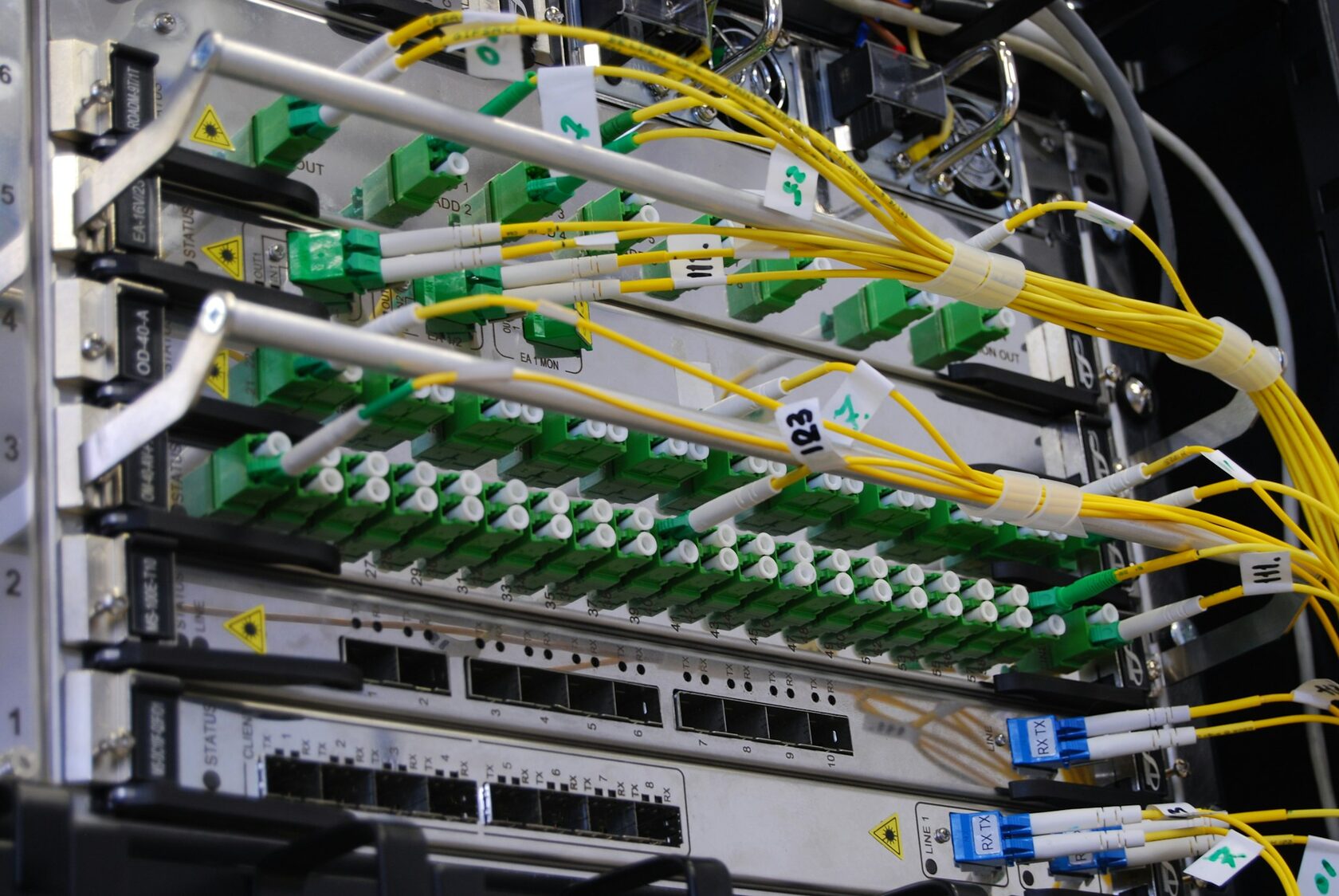
At the European Conference on Optical Communication (ECOC 2026) in Malaga, engineers presented an operational architecture for Joint Communication and Sensing. Technical specialists from Adtran demonstrated methods for embedding high-spatial-resolution distributed acoustic sensing (DAS) directly into live fiber lines carrying active high-speed DWDM data channels.
Accidental mechanical strikes from excavators and unauthorized trenching cause the majority of long-haul telecommunication outages. Operators historically deployed vibration monitoring only across dark fibers to prevent Rayleigh backscatter interference from degrading active communication channels. The updated architecture relies on precise wavelength division: the optical interrogator probes the fiber on a dedicated wavelength isolated from operational C-band and L-band transmission windows.
Engineers mitigated nonlinear cross-talk in optical amplifiers by regulating laser pulse peak power and introducing steep optical bandpass filters. This design delivers continuous acoustic telemetry over tens of kilometers without increasing bit error rates (BER) across active 400G and 800G optical channels. The sensing unit detects heavy machinery approaching the cable trench minutes before physical contact occurs.
The Ksense K-DAS platform develops direct compatibility with optical DWDM multiplexers, enabling operators to protect critical communication backbones without dedicating isolated fiber cores.